Einzelzahnimplantat
Was ist ein Einzelzahnimplantat?
Hier erfahren Sie, wie ein Einzelzahnimplantat aufgebaut ist, wann es in Frage kommen kann und welche Alternativen es gibt. Die Informationen ersetzen keine persönliche Untersuchung.
Was ist ein Einzelzahnimplantat?
Ein Implantat ersetzt genau einen Zahn.
Ein Einzelzahnimplantat ersetzt die Wurzel und die Krone eines fehlenden Zahns. Fehlt ein einzelner Zahn und sind die Nachbarzähne gesund, wird häufig zu einem Implantat geraten, weil die Nachbarzähne dafür nicht beschliffen werden müssen. Wie eine natürliche Wurzel überträgt das Implantat Kaukräfte auf den Knochen. Je nach Befund können aber auch eine Brücke oder eine Teilprothese gut geeignet sein.
- 01
Implantatkörper
Eine künstliche Zahnwurzel in Schrauben- oder Zylinderform, meist einige Millimeter bis etwa 1,5 cm lang. Sie wird im Kieferknochen verankert, wo der Knochen in den folgenden Monaten fest an ihre Oberfläche anwächst (Osseointegration). Das gängigste Material ist Titan, das in der Regel sehr gut verträglich ist; Implantate aus Keramik (Zirkonoxid) sind eine mögliche Alternative.
- 02
Aufbau (Abutment)
Das Verbindungsstück zwischen Implantat und Krone. Bei manchen Systemen sind Implantat und Aufbau aus einem Stück gefertigt.
- 03
Implantatkrone
Der sichtbare Teil, auch Suprakonstruktion genannt. Die Krone, etwa aus Keramik oder Metallkeramik, wird in Form und Farbe an Ihre Nachbarzähne angepasst und verschraubt oder zementiert.
Grundlagen zu Aufbau und Alternativen: IQWiG: Zahnersatz und EFP: Dental implants explained.
Making an informed choice
Bridge or implant?
Neither option is automatically best. The health of neighboring teeth, available bone, surgical risks, your preferences and the overall costs all matter.
| Aspect | Gap left open | Conventional bridge | Single-tooth implant |
|---|---|---|---|
| Neighboring teeth | May tilt or drift towards the gap; this varies between people. | Supporting teeth are usually prepared for crowns. This may be reasonable when they are already heavily damaged. | Neighboring teeth generally do not need to be prepared for the implant crown. |
| Surgery & time | No replacement treatment initially; review remains important. | No implant surgery or bone-integration phase; several appointments are still required. | Surgery and usually several months until completion; grafting may add treatment stages. |
| Bone | Bone at the missing-tooth site can shrink over time. | The missing root is not replaced; bone shrinkage remains possible. | Enough bone is needed or must be reconstructed. Bone loss can also occur around implants. |
| Risks & care | Possible changes in bite, chewing function or tooth position. | Decay, problems with supporting teeth and technical complications are possible. Clean beneath the replacement tooth too. | Healing problems, inflammation with bone loss and technical complications are possible. Careful hygiene and reviews are essential. |
| Costs & future costs | No replacement costs initially; later treatment may still be needed. | Depend on materials and supporting teeth; allow for possible repairs or replacement. | Compare surgery, implant, abutment and crown, plus any grafting and temporary restoration. Maintenance, repairs and replacement may add future costs. |
If neighboring teeth already need crowns, a bridge may be a reasonable choice. If they are healthy, avoiding preparation may favor an implant, provided surgery is appropriate.
An adhesive bridge is different from a conventional bridge: it is bonded with one or more wings and may preserve more tooth structure, particularly for suitable anterior gaps. Its suitability depends on the bite and supporting tooth. A tooth that can be preserved should not be extracted simply to place an implant.
General orientation, not an individual recommendation. Sources: IQWiG [1], EFP [2], Mayo Clinic [3].
Zeitpunkt & Alternativen
Sofort, früh oder spät implantieren?
Der passende Zeitpunkt hängt vom Zustand des Knochens und des Zahnfleischs ab und wird individuell festgelegt.
Zeitpunkte nach ITI-Konsens [9]; Sofortimplantation und Sofortbelastung sind getrennt zu beurteilen: ITI 2023 [4].
Am Tag der Zahnentfernung
Sofortimplantation
Das Implantat wird direkt nach der Entfernung gesetzt. Voraussetzung sind in der Regel entzündungsfreie Verhältnisse und ausreichend Knochen.
Nach etwa 4–8 oder 12–16 Wochen
Frühimplantation
Je nach Befund wird nach Abheilung des Weichgewebes (4–8 Wochen) oder nach teilweiser Knochenheilung (12–16 Wochen) implantiert. Eine provisorische Versorgung kann die Wartezeit überbrücken.
Nach vollständiger Knochenheilung, meist über 6 Monate
Spätimplantation
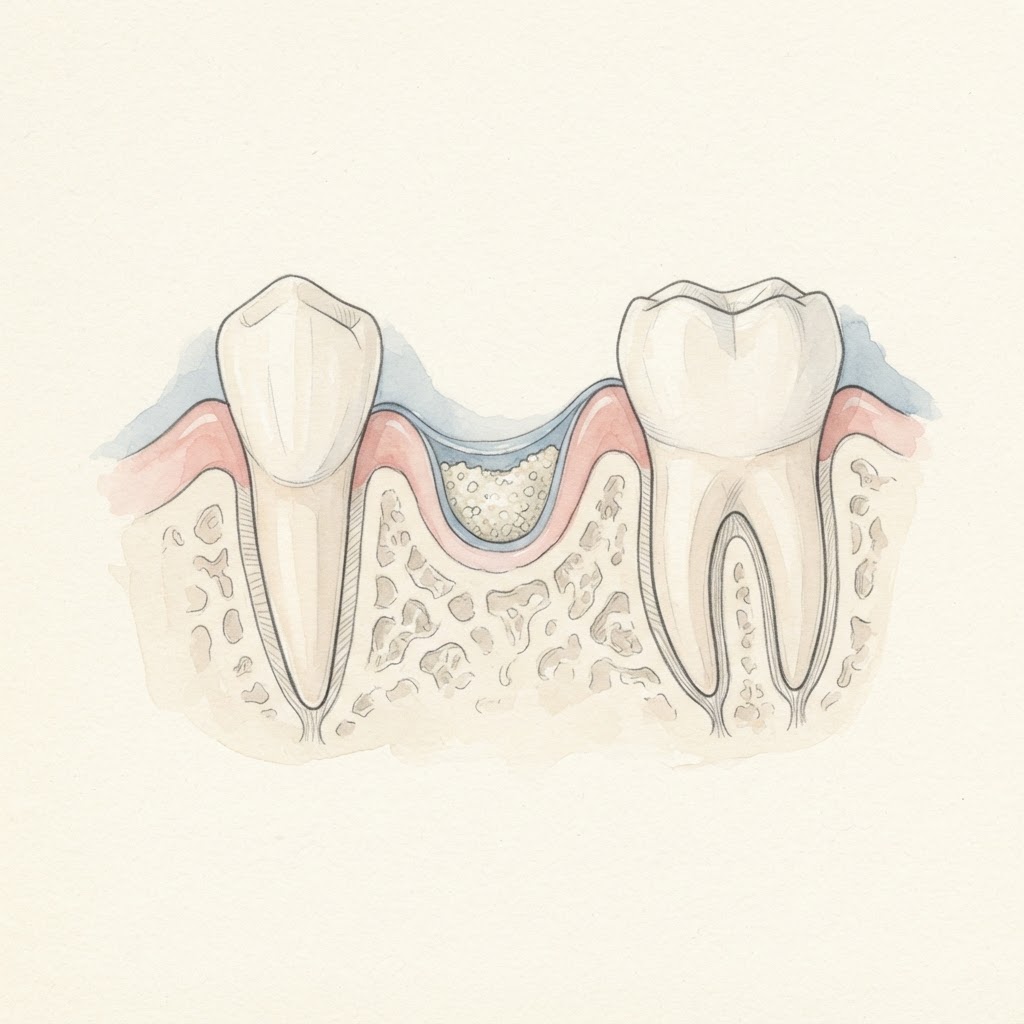
Nach Zahnverlust können sich Knochen und Zahnfleisch zurückbilden, besonders in den ersten Monaten. Ob ein Knochenaufbau nötig ist, entscheidet der Befund, nicht die Wartezeit allein.

Alternativen zum Implantat
Zahnbrücke
Die Nachbarzähne werden beschliffen, überkront und tragen den Ersatzzahn. Kein chirurgischer Eingriff nötig, oft sinnvoll, wenn die Nachbarzähne ohnehin Kronen brauchen.
Klebebrücke
Ein Ersatzzahn wird mit kleinen Flügeln an der Innenseite der Nachbarzähne festgeklebt, vor allem im Frontzahnbereich.
Teilprothese
Herausnehmbarer Zahnersatz, oft als Übergangs- oder kostengünstigere Lösung.
Lücke belassen
In manchen Fällen, etwa bei Weisheitszähnen, kann auch keine Versorgung vertretbar sein.
Individual planning
Front tooth & bone grafting.
In the visible zone, the gum contour matters as much as the crown. Bone and soft tissue determine what is possible and how long treatment may take.
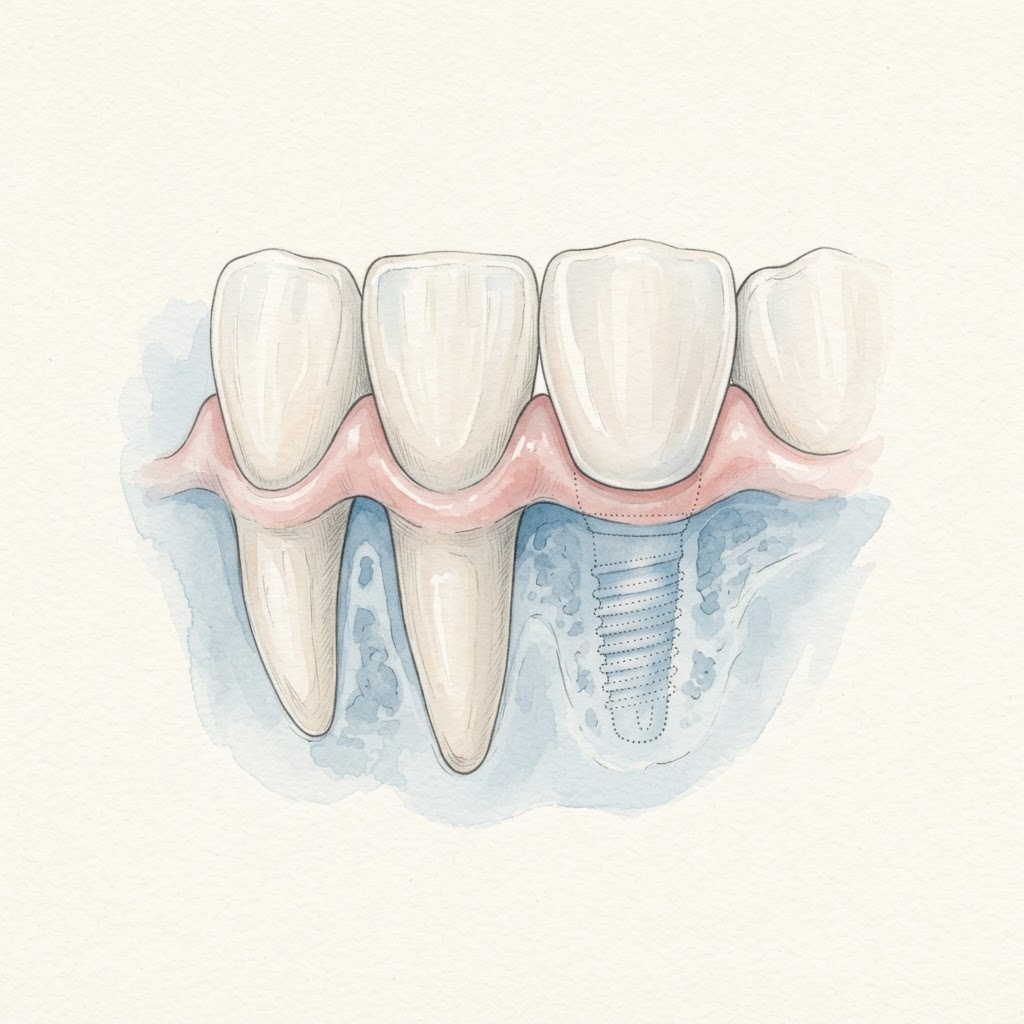
In the front of the mouth, tooth shape, shade, the gum margin and the small triangles of gum between teeth all affect appearance. Assessment therefore includes the facial bone wall, gum thickness and the position of adjacent teeth, not just the gap.
Thin tissues or a damaged facial bone wall can increase the risk of visible changes. Bone or soft-tissue grafting may be appropriate. A particular aesthetic result or an unchanged gum contour cannot be guaranteed.
Individual tissue assessment, not a promise of perfect aesthetics. Schematic AI illustration, not a patient case. Source [4]
Behandlungsablauf
In sechs Schritten zum neuen Zahn.
Klicken Sie auf einen Schritt, um mehr zu erfahren. Bis zur endgültigen Krone dauert es häufig mehrere Monate; Vorbehandlungen oder Knochenaufbau können den Ablauf verlängern. Eine Sofortimplantation bedeutet nicht automatisch eine sofort belastbare Krone. Dauer und Ablauf werden individuell geplant.
Grundlagen zum Ablauf und zur Einheilung: EFP: Dental implants explained und Mayo Clinic: Dental implant surgery. Zeitangaben dienen nur der Orientierung.

Sicherheit & Nachsorge
Gut informiert, gut begleitet.
Grundlagen: Mayo Clinic: Eingriff und Risiken, EFP-S3-Leitlinie: Prävention und Nachsorge, AWMF: Knochenantiresorptiva.
Sicherheitshinweise
- Nach dem Eingriff können Schmerzen, Schwellungen und Blutergüsse auftreten. Schmerzmittel und Verhalten nach der Operation werden individuell besprochen; bei zunehmenden Beschwerden bitte die Praxis kontaktieren.
- Mögliche Komplikationen sind Wundinfektionen, Nachblutungen und in seltenen Fällen Nervenirritationen. Selten wächst ein Implantat nicht ein (Frühverlust).
- Rauchen, unbehandelte Parodontitis, schlecht eingestellter Diabetes, Gerinnungsstörungen oder ein geschwächtes Immunsystem erhöhen das Risiko. Bei Osteoporose-Medikamenten wie Bisphosphonaten oder Denosumab ist eine besonders sorgfältige Abklärung nötig.
- Implantate werden erst nach Abschluss des Kieferwachstums gesetzt, also meist ab etwa 18 Jahren.
- Ein Behandlungserfolg kann nicht garantiert werden. Wir klären Sie vor jedem Eingriff ausführlich auf.
Nachsorge
- Implantate bekommen keine Karies, das Zahnfleisch rund um ein Implantat ist aber empfindlicher als um natürliche Zähne.
- Zweimal täglich Zähne putzen und einmal täglich die Zwischenräume mit Interdentalbürstchen oder Zahnseide reinigen.
- Regelmäßige Kontrollen und professionelle Reinigungen in dem Abstand, den wir für Sie festlegen.
- Warnzeichen einer Entzündung (Mukositis bzw. Periimplantitis): Zahnfleischbluten, Schwellung, Mundgeruch oder schlechter Geschmack, Lockerung. Bitte melden Sie sich dann zeitnah, da eine unbehandelte Periimplantitis zum Implantatverlust führen kann.
- Nicht zu rauchen verbessert die Aussichten auf eine lange Haltbarkeit deutlich.
Erste Orientierung
Vier Fragen zu Ihrer Situation.
Diese Fragen ersetzen keine ärztliche Untersuchung, können Ihnen aber eine erste Einordnung geben.
Frage 1 von 4
Fehlt der Zahn bereits oder ist er noch vorhanden?
Your next step
From your enquiry to personal advice.
General information helps you prepare. Together, we clarify what may be appropriate for your situation.
- 01
Send your enquiry
Use the contact form to describe which tooth is affected, any symptoms and how you would like to be contacted. An enquiry does not commit you to treatment.
- 02
Prepare for the consultation
If available, bring existing X-rays, dental findings and a treatment plan, plus your current medication list and information about medical conditions and allergies. Missing documents do not prevent an initial consultation.
- 03
Decide after examination
We discuss whether the tooth can be preserved, possible alternatives, risks and timing. A reliable treatment recommendation requires an examination; treatment begins only after you have been informed and have consented.
Who will advise and treat you?
Treatment takes place at the Albertine practice in St. Andrä-Wördern near Vienna. Practice owner Dott. Mag. DDr. Christian Müller-Guttenbrunn holds the Austrian Dental Chamber’s continuing education diploma in implantology. The team includes DDr. Onur Dogru, a specialist in oral and maxillofacial surgery. We clarify who will perform each stage during your personal consultation.
Sources
Sources & further reading
| # | Title | Year | Link |
|---|---|---|---|
| 1. | Kronen, Brücken, Implantate: Welche Arten von Zahnersatz gibt es? | o. J. | Source |
| 2. | Dental implants explained | o. J. | Source |
| 3. | Dental implant surgery | 2024 | Source |
| 4. | Selection Criteria for Immediate Implant Placement and Immediate Loading for Single Tooth Replacement in the Maxillary Esthetic Zone | 2023 | Source |
| 5. | A systematic review of post-extractional alveolar hard and soft tissue dimensional changes in humans | 2012 | PubMedPMID: 22211303 |
| 6. | Prevention and treatment of peri-implant diseases—The EFP S3 level clinical practice guideline | 2023 | PubMedPMID: 37271498 |
| 7. | Systematic review of the survival rate and the incidence of biological, technical, and aesthetic complications of single crowns on implants reported in longitudinal studies with a mean follow-up of 5 years | 2012 | PubMedPMID: 23062124 |
| 8. | Zahnimplantate bei medikamentöser Behandlung mit Knochenantiresorptiva (inkl. Bisphosphonate) | 2026 | Source |
| 9. | Implant Placement and Loading Protocols | 2018 | Source |
| 10. | Zahnersatz und Implantate | o. J. | Source |
| 11. | Implantate: Was übernimmt die Krankenkasse? | o. J. | Source |
| 12. | Zahnersatz – Bewilligung, Kostenersatz, Behandlungsbeitrag | o. J. | Source |
Sources checked on 11 November 2026. [1–3]: implant components, alternatives, treatment and grafting; [4, 9]: timing and immediate restoration; [5]: bone changes after extraction, not a fixed six-stage progression; [6]: prevention, risk factors and follow-up; [7]: survival of implants supporting single crowns, not a guarantee or crown survival; [8]: antiresorptive medicines; [10–12]: insurance benefits in Austria and Germany. Research reviews, guidelines and patient information serve different purposes. o. J. means no publication year recorded. Individual dental assessment remains essential.